
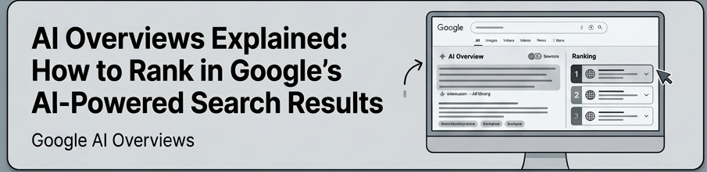
When Google rolled out AI-generated summaries at the top of search results, it fundamentally changed what ranking first means. Google AI Overviews now often appear before any traditional blue link, pulling information from multiple sources into one synthesized answer. Understanding how these summaries are built, and how to be included in them, has become essential for any business that depends on organic search traffic.
How Google Builds AI Overviews
Google AI Overviews are generated using a mix of Google’s search index, structured data, and real-time content evaluation, rather than a single ranked source. Multiple pages are often synthesized together, meaning several competitors can appear as sources within the same summary.
Because multiple sources often get blended into a single summary, being technically correct isn’t always enough on its own — your content also needs to be distinct enough that it adds something the other cited sources don’t. Repeating the same generic advice found across dozens of competing pages rarely earns a citation, while a specific example, original statistic, or clearly explained process tends to stand out. Businesses that audit their content against what’s already ranking, and look for genuine gaps to fill rather than rephrasing existing advice, tend to see stronger citation results over time.
- Clear, factual statements that can be verified against multiple sources.
- Pages with strong topical authority on the specific query.
- Structured data that removes ambiguity about what a page is actually about.
Strategies to Get Cited in AI Overviews
Improving your odds of appearing in Google AI Overviews requires a slightly different approach than chasing the number one organic spot, since the goal shifts from earning a single ranked slot to becoming one of the sources a summary chooses to synthesize.
- Answer the core query in the first two sentences of the page.
- Use original data or statistics that are difficult for AI to source elsewhere.
- Maintain strong E-E-A-T signals, including author credentials and citations.
- Keep content updated so it reflects the most current information available.
What This Means for Website Traffic
Some businesses have seen click-through rates drop as users get their answers directly from the summary without visiting a website. This makes it more important than ever to earn the citation itself, since being named as a source still builds brand recognition even without a click. Businesses that adapt their content strategy toward being the trusted, cited source, rather than chasing clicks alone, tend to fare better long term.
It also means traffic quality can shift, since visitors who do click through after seeing a summary are often further along in their research and more likely to convert. Rather than viewing every impression inside an AI Overview as a lost opportunity, it helps to reframe it as a form of brand exposure that happens before the click, similar to how a billboard builds recognition without requiring immediate action. Businesses that track brand mentions and citation frequency alongside traditional traffic metrics get a more complete picture of how this new search format is actually performing for them, rather than judging success by clicks alone.
Optimizing Existing Content for AI Overviews
Rather than creating entirely new pages, most businesses can improve their chances with Google AI Overviews by refining what’s already performing well.
- Audit top-performing pages and tighten their opening paragraphs.
- Add clear statistics, dates, and sourcing wherever claims are made.
- Break long sections into scannable subheadings with direct answers.
Frequently Asked Questions
What are Google AI Overviews?
AI Overviews are Google’s AI-generated summaries that appear at the top of search results, synthesizing information from multiple sources into one answer. They often appear before traditional organic listings.
Can I opt out of appearing in AI Overviews?
Google offers limited controls through structured data and crawler directives, but there is no simple universal opt-out for AI Overviews specifically. Most businesses instead focus on optimizing to be included and cited well.
Do AI Overviews reduce website traffic?
Some websites see fewer clicks when users get answers directly from the summary, though being cited still builds brand visibility. Traffic impact varies significantly by industry and query type.
How is this different from featured snippets?
Featured snippets typically pull from a single source, while AI Overviews often synthesize several sources into one combined answer. This means visibility inside an Overview can come from being one of multiple contributing sources.
What content works best for AI Overviews?
Clear, factual, well-sourced content with direct answers near the top of the page performs best. Original data and strong topical authority also improve citation odds.
Conclusion
AI Overviews aren’t going away, and businesses that ignore them risk losing visibility at the exact moment customers are searching. Treating Google AI Overviews as a core part of your SEO strategy, not an afterthought, will determine whether you’re the cited source or an invisible competitor. Start by tightening your highest-value pages, adding stronger sourcing, and monitoring how often your brand appears in these summaries. The businesses that adapt now will hold a real advantage as AI-powered search continues to grow.