
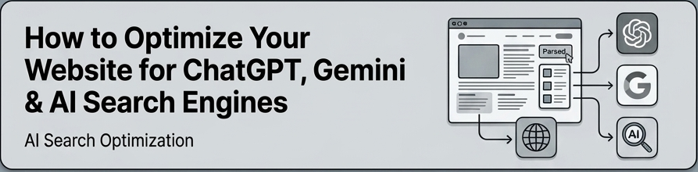
More shoppers are now typing questions into ChatGPT or Gemini before they ever open Google. If your website isn’t built for this shift, you’re already losing visibility to competitors who understand AI Search Optimization. AI Search Optimization is the process of adapting your website’s structure, content, and technical setup so large language models can crawl, understand, and recommend it. This guide breaks down exactly what that means in practice, without the jargon.
Why AI Search Engines Read Websites Differently
Unlike a traditional crawler that indexes pages for a ranked list, AI search tools use retrieval systems that pull small chunks of text to answer a specific question. This means AI Search Optimization depends heavily on how cleanly your content is chunked into logical sections with clear headers.
This retrieval-first approach also changes how much weight individual pages carry relative to the site as a whole. A single page can rank well in traditional search while still being ignored by an AI system if it lacks the surrounding context — internal links, author information, and related content — that helps a model judge its trustworthiness. Businesses that think about their site as a connected body of knowledge, rather than a collection of standalone pages competing for keywords, tend to build the kind of structural clarity that both search engines and AI systems reward.
- Semantic HTML (proper H1-H3 tags) becomes more important than ever.
- Page speed and crawlability still matter, since slow or blocked pages get skipped.
- Content freshness signals carry more weight, as models often prioritize recently updated sources.
Practical Steps to Optimize for ChatGPT and Gemini
Getting your site ready for AI Search Optimization starts with technical basics and extends into content strategy.
- Add a clear robots.txt policy that doesn’t block AI crawlers you want indexing you.
- Use schema markup for products, FAQs, and articles so context is unambiguous.
- Write concise, factual summaries near the top of each page.
- Build internal links between related pages to reinforce topical depth.
Common Mistakes That Hurt AI Visibility
Many businesses unintentionally block themselves out of AI search results. Overly long introductions, vague headlines, and content hidden behind heavy JavaScript rendering are some of the most common issues, since not every crawler executes scripts the way a browser does. Other frequent mistakes include duplicating content across multiple pages, which confuses retrieval systems about which version to cite, and neglecting author or business information that would otherwise establish trust.
These issues compound if left unaddressed, since search engines and AI models increasingly treat technical hygiene as a baseline trust signal rather than a bonus. A page that loads slowly, buries its answer under filler text, or contradicts information found elsewhere on the same site sends a weak signal about reliability, and AI systems are quick to favor a cleaner alternative instead. The good news is that most of these fixes overlap heavily with practices you may already follow for traditional SEO. Cleaning up thin or duplicate pages, tightening site structure, and writing with more precision benefits both classic rankings and AI-driven visibility at the same time, which makes this an efficient investment rather than a separate workstream. Businesses that treat this as ongoing maintenance, rather than a one-time project, tend to hold their visibility gains for much longer.
Testing Whether Your Site Is AI-Search Ready
A simple way to check your progress with AI Search Optimization is to ask ChatGPT or Gemini a question your business should be able to answer, then see whether your site appears in the response.
- Search your brand name plus your main service in an AI chat tool.
- Ask a common customer question and see which sources get cited.
- Review whether competitors are being quoted instead of you.
Frequently Asked Questions
What is AI Search Optimization?
AI Search Optimization is the practice of structuring a website so AI-driven search tools like ChatGPT and Gemini can crawl, interpret, and recommend its content. It combines technical SEO with clearer, more direct writing.
Do I need to block AI crawlers?
Most businesses benefit from allowing reputable AI crawlers, since being cited in AI answers increases visibility. Blocking them entirely can mean losing an entire channel of potential customers.
Does page speed affect AI search visibility?
Yes, slow-loading pages can be skipped or deprioritized by crawlers, similar to how they affect traditional SEO rankings. Fast, clean-loading pages remain easier for both humans and machines to process.
How is this different from regular SEO?
AI Search Optimization overlaps with SEO but places more emphasis on direct answers, structured data, and content chunking for retrieval-based systems. Traditional SEO focuses more heavily on backlinks and keyword rankings.
How often should I update my content?
Refreshing key pages every few months signals relevance to AI models, which often weight recency in their sourcing decisions. Outdated statistics or broken information can quickly cost you a citation.
Conclusion
The businesses winning attention in 2026 are the ones treating AI Search Optimization as seriously as they once treated traditional SEO. Clean structure, clear answers, and consistent technical maintenance are what separate a site AI tools trust from one they skip entirely. Start with a technical audit, tighten your content structure, and test your visibility across the major AI platforms. The sooner you adapt, the more of this new traffic channel you’ll capture before your competitors do.